Structuring your lot numbering: the foundation that makes everything else possible
A badly designed lot number breaks traceability before the first scan. What an identifier must encode, the pitfalls of numbering by date alone, and how to migrate without losing the history.

The QR code, the product page, the four-hour recall — everything that makes traceability usable rests on a single decision taken upstream: how a lot is numbered. A badly designed identifier goes unnoticed as long as no incident occurs; it reveals itself precisely on the day you need it most.
What the law requires, before what practice recommends
The lot number is not an internal good practice: it is a mandatory particular, laid down by Directive 2011/91/EU of 13 December 2011 (which replaced Directive 89/396/EEC).
Three points in the text decide how you number:
- The definition of a lot — “a batch of sales units of a foodstuff produced, manufactured or packaged under practically the same conditions”. It is this wording, and not an in-house convention, that says where a lot ends.
- Who determines it — the producer, manufacturer or packager, or failing that the first seller established within the Union. In other words, if nobody upstream has done it, the responsibility falls to you.
- The letter “L” — the number must be preceded by it, except where it is clearly distinguishable from the other particulars on the label.
And one exception that explains why some products display no lot at all: the particular is not required if the date of minimum durability or the “use by” date appears on the label with the day, the month and the year. An incomplete date (month and year only) is therefore not enough to be exempt.
What a lot number must guarantee
Three properties, non-negotiable:
- Uniqueness: two different production runs never share the same number, even when only a few hours apart.
- Stability: a lot number, once assigned, is never reassigned to another production run, even years later.
- Legibility: the number must be readable and transcribable without error, by hand if necessary — a code that is too long or made of ambiguous characters (0/O, 1/I) generates cascading input errors.
The pitfall of numbering by date alone
Using the day’s date as the sole identifier (20260811) seems sufficient as long as only one production run takes place per day. The system breaks as soon as:
- Two different production runs take place on the same day (two vats, two recipes).
- A production run spans two calendar days — which day do you keep?
- A lot is reworked or repackaged later — does it need a new date, or does it keep the original one?
A robust identifier separates the date from a counter or a workshop code: 20260811-A1 rather than 20260811 alone. The suffix absorbs the collision without breaking chronological readability.
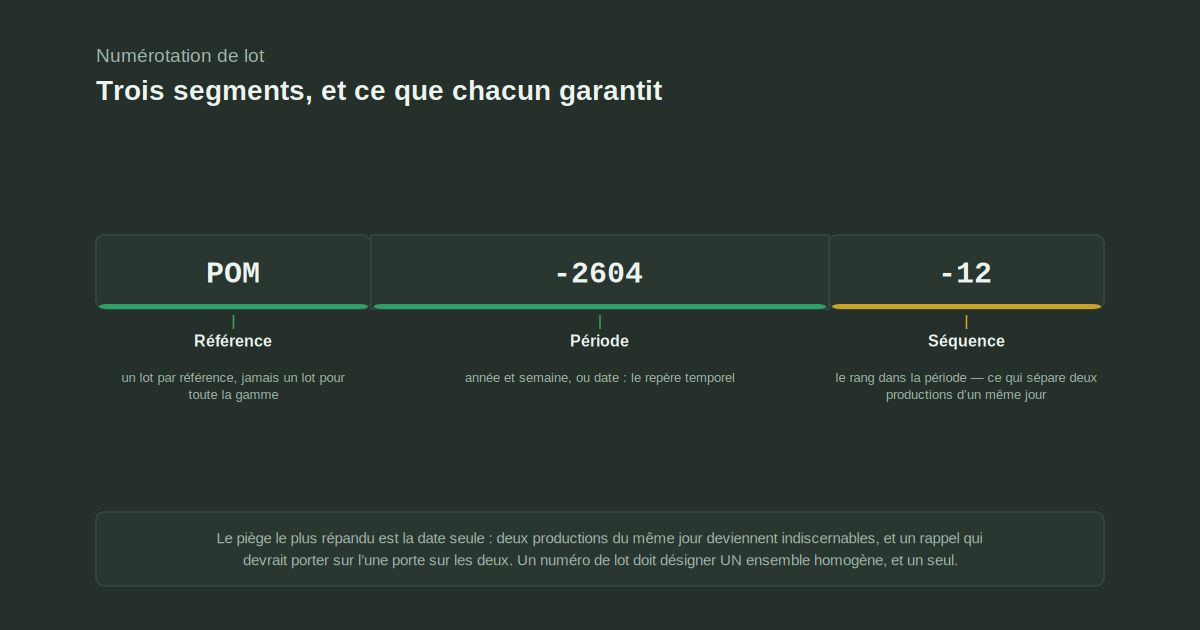
One lot per product reference, not one lot for the whole range
A single lot number must never cover two different product references, even when they come from the same process on the same day. Two cheeses ripened differently from the same milk remain two distinct lots as soon as their composition or treatment diverges — otherwise a recall of one mechanically drags in the other, or worse, misses one.
Composite lots: when one lot contains several others
A processed product (recipe, blend) breaks the simple link “one incoming lot = one outgoing lot”. Two approaches:
- Traceability by production run: each manufacturing lot keeps the list of upstream lots used (raw material, ingredients), time-stamped at production. This is the most reliable method, but it assumes systematic recording at every production run.
- Traceability by period (less precise, acceptable for small volumes): the outgoing lot references all the upstream lots received over a given time window. In the event of a recall, the scope to withdraw is wider — that is the trade-off of this method.
Migrating an existing system without losing the history
Changing numbering format mid-activity is common — a software change, a requirement from a new distributor, a move to digital. Three rules so that the migration breaks nothing:
- Never reassign an old number under the new format, even if the format changes. A product still in circulation with the old number must remain traceable with it.
- Document the switchover date between the two formats — an inspector or a customer looking for a lot must know which of the two systems applies to which period.
- Keep a correspondence table if the same product exists under both numberings during a transition period (old stock still on the shelf, new stock already produced).
Common mistakes
- A counter reset to zero every year without including the year in the number — two lots two years apart then share the same identifier.
- A number assigned to the order, not to the production run — if one production run serves several orders, the lot number must remain unique per production run; the order is separate information.
- Ambiguous characters (0/O, 1/I/l) that cause manual input errors at goods-in or during an inspection.
- No written rule — the numbering lives in the head of a single person, which becomes a breaking point as soon as they are absent on the day of an inspection or a recall.
Checklist
- One unique identifier per production run, never reassigned.
- Date + counter or workshop code, never the date alone.
- One lot per product reference — never a lot shared between several different products.
- A written rule for composite lots (by production run or by period).
- A documented migration procedure if the format changes.
- No ambiguous characters in the chosen format.
Sources
- Directive 2011/91/EU of 13 December 2011, EUR-Lex — definition of a lot, who is responsible for determining it, the letter “L”, exemption linked to a complete date of minimum durability or “use by” date.
Verified 17 August 2026.
Cosa cambia per Lei
Lo stesso ragionamento non si gioca nello stesso punto a seconda del vostro posto nella filiera.
Lei è un produttore
If your lot number is simply the day’s date, two production runs on the same day share the same identifier. This guide explains how to avoid that collision without making your records more complicated.
VeraTrace per i produttori →Lei trasforma, è un marchio
A lot that blends several upstream lots must be able to prove it — the section on internal traceability covers how to name a lot made from a blend without losing the link to its components.
VeraTrace per i trasformatori →Lei è un distributore o una centrale d’acquisto
A lot number that is illegible at goods-in slows down every check. The guide gives the legibility criteria you can require from a supplier without imposing a disproportionate system on them.
VeraTrace per la distribuzione →