EUDR: what a company risks in the event of non-compliance
Fines, confiscation, exclusion from public procurement, withdrawal from the market: the penalties provided for by the EUDR, who applies them in France, and how an inspection is triggered in practice.
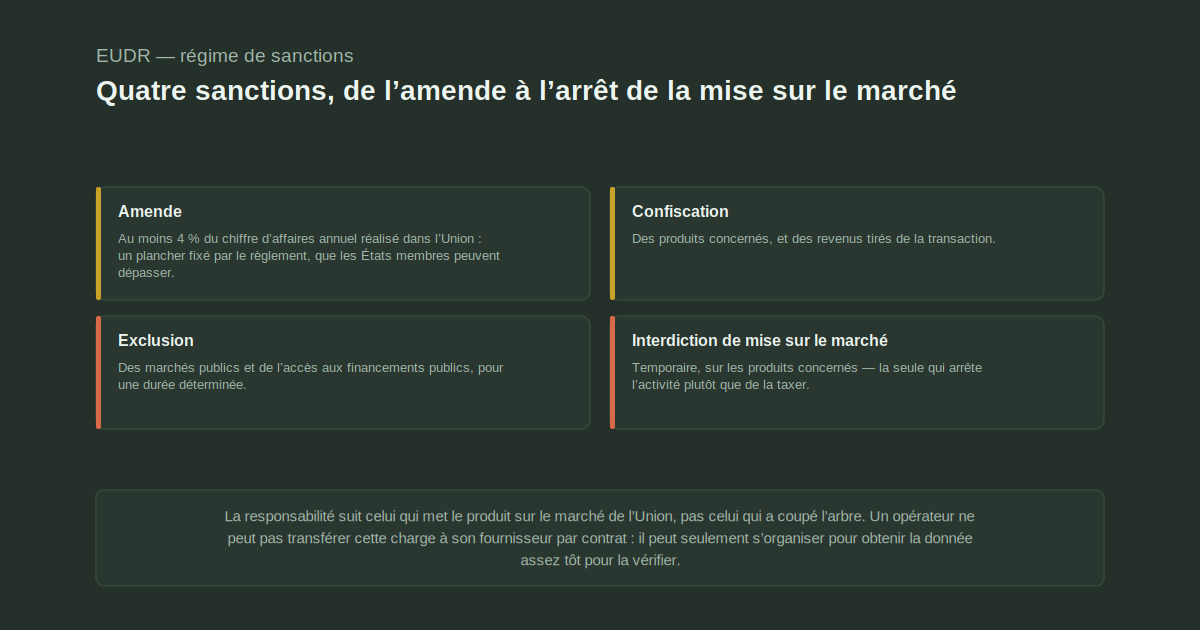
The EUDR leaves it to the Member States to define the precise penalties applicable, within a common framework set by the European text. This guide details that framework, its application in France, and what actually triggers an inspection.
The common framework set by the European regulation
The EUDR requires Member States to provide for penalties that are “effective, proportionate and dissuasive”, with a common baseline:
- Fines calculated in proportion to the environmental damage and the value of the products concerned. The regulation imposes on States a floor on the maximum incurred: for a legal person, the maximum fine may not be set below 4% of the annual turnover achieved in the Union in the year preceding the decision.
- Confiscation of non-compliant products, as well as of the revenues gained from placing them on the market.
- Temporary exclusion from public procurement procedures and from access to public funding.
- Suspension of the right to place on the market for the operator concerned, in the most serious cases.
Calculating the fine, and the misreading to avoid on the 4%
You very often read “a fine of up to 4% of turnover”. That is the opposite of what Article 25 says.
The 4% is not a ceiling: it is a floor imposed on Member States on the ceiling they must provide for. A State may go higher, never lower. Reading “up to 4%” therefore leads you to underestimate the maximum exposure, and to believe you know the amount when it depends on the national transposing law.
What remains true of proportionality: an identical infringement exposes a large company to an amount in absolute terms far higher than that for a small business. The exact amount and the method of calculation are a matter for the country where the product is placed on the market — that is where to check, not in the regulation.
Who is responsible, in a supply chain
Since Regulation (EU) 2025/2650 of 19 December 2025, which amended the EUDR, the chain has three roles, and only one of them files a statement:
- The operator: the one who places the product on the European market for the first time, or exports it. It is the operator who files the due diligence statement and carries the main responsibility in the event of non-compliance. A micro or small primary operator established in a low-risk country instead files a single simplified declaration.
- The downstream operator: the one who places on the market, or exports, a product made from products already covered by a statement — a roaster processing green coffee that has already been declared, for example. It no longer files its own statement: it collects and keeps the reference number of the initial statement.
- The trader: the one who buys and resells a product already placed on the market, without processing it. Same regime: it does not file, but it must be able to identify its direct suppliers and customers, and keep the reference number of the statement for the product it resells.
Processing a product therefore no longer, on its own, turns a company into a filer. A company that imports the green coffee it roasts, on the other hand, remains the operator for that coffee: it is the first placing on the market that decides the role, not the processing.
These obligations apply from 30 December 2026, and from 30 June 2027 for micro and small enterprises that meet the conditions of the deferral (see our guide on the EUDR timeline) — it is from those dates that a breach can be penalised.
Who applies them in France
Article 14 of the regulation requires each Member State to designate a competent authority. In France, it is a joint competent authority: the Ministry of Ecological Transition and the Ministry of Agriculture. It is this authority that carries out the inspections described below and to which you respond when it requests information.
Your chances of being inspected are written into the regulation
The regulation does not leave the intensity of inspections to the discretion of States: it sets minimum annual rates, indexed to the risk classification of the country of production.
| Country classification | Minimum annual checks | |---|---| | High risk | 9% of operators and 9% of quantities | | Standard risk | 3% of operators | | Low risk | 1% of operators |
Two useful readings. The first: for a high-risk origin, nearly one operator in eleven is inspected each year — this is no longer a theoretical risk. The second: it is the country of origin that determines your exposure, not your size or how long you have been operating. Changing the source of your raw material mechanically changes your probability of being inspected.
How an inspection is triggered
The competent authorities of each Member State apply a risk-based approach: the categories of commodities, countries of origin and operators presenting a higher risk of deforestation are subject to a higher inspection rate. An inspection can also be triggered by a report, or by a consistency check between the filed statement and the satellite imagery available to the authorities.
What actually reduces the risk
- A due diligence statement filed with precise and verifiable plot coordinates, not approximate ones.
- Documentation kept and updated with every change of supplier or plot of origin.
- A prompt and complete response to any request for additional information from the competent authority — silence or an incomplete answer generally makes the situation worse than an isolated but documented non-compliance.
Common mistakes
- Thinking a flat-rate fine applies — the amount depends on turnover and severity, not on a single fixed scale.
- Ignoring the role of trader or downstream operator in the belief that only the original operator carries a risk — a company that can identify neither its supplier nor the reference number of the associated statement is also exposed.
- Continuing to file a statement at every processing step when, since Regulation (EU) 2025/2650, the downstream operator keeps the reference number of the initial statement instead of filing one.
- Not responding to a request from the competent authority within the time allowed, which often turns a file that could have been regularised into one that is penalised.
Checklist
- Identify your exact role (operator, downstream operator or trader) for each product concerned, and the date that applies to it (30 December 2026, or 30 June 2027 for a micro or small enterprise outside the timber sector established no later than 31 December 2024).
- Check that the due diligence documentation is up to date, not merely filed once.
- Prepare a procedure for responding quickly to a request from the competent authority.
- Check with the competent national authority the precise penalty arrangements applicable in the country where the product is placed on the market.
Sources
- Regulation (EU) 2023/1115, Article 25, EUR-Lex — nature of the penalties and the 4% floor.
- Delay until December 2026 and other developments in the implementation of the EUDR, Access2Markets, European Commission — roles amended by Regulation (EU) 2025/2650: downstream operators and traders, simplified declaration, application dates.
- Règlement européen contre la déforestation et la dégradation des forêts (European regulation against deforestation and forest degradation), French Ministry of Ecological Transition — joint competent authority in France.
- Fighting deforestation and forest degradation, official EUR-Lex summary — inspection rates by risk classification.
Verified on 17 August 2026; roles and competent authority rechecked on 25 September 2026.
Cosa cambia per Lei
Lo stesso ragionamento non si gioca nello stesso punto a seconda del vostro posto nella filiera.
Lei è un produttore
It is the operator placing the product on the market — often your direct buyer, not you — who carries most of the filing responsibility. This guide clarifies that division so you do not wrongly carry a risk that is not yours.
VeraTrace per i produttori →Lei trasforma, è un marchio
An EUDR fine is calculated in proportion to turnover, not as a fixed amount — which changes the order of magnitude of the risk depending on the size of the company. The section “Calculating the fine” explains the mechanism.
VeraTrace per i trasformatori →Lei è un distributore o una centrale d’acquisto
The regulation places responsibility on the operator that places a product on the market, not only on the one that produced it — this guide clarifies who, in a supply chain, carries the risk of a penalty.
VeraTrace per la distribuzione →