No Starling Knows the Murmuration
Thousands of birds draw a shape none of them holds, while watching only seven neighbours. What their flight says about a food chain nobody sees whole.

At dusk, the starlings gather.
A few dozen at first, then hundreds, sometimes thousands. The group contracts, stretches, turns sharply, splits and rejoins. From the ground it seems to become a single organism. A wave, a cloud, a dark stain endlessly changing shape.
This is called a murmuration.
The temptation is to look for a leader. A bird out in front, a trajectory decided somewhere, a signal the others follow.
There is none.
Seven neighbours, and nothing else
In 2008, the STARFLAG project published a three-dimensional reconstruction of starling flights filmed above Rome. The finding is stranger than the absence of a leader.
Each bird doesn’t adjust to everything around it, nor to everything within some radius. It adjusts to its six or seven nearest neighbours, counted by rank — the first, the second, the seventh — whatever distance they happen to be at.
The distinction sounds technical. It decides everything.
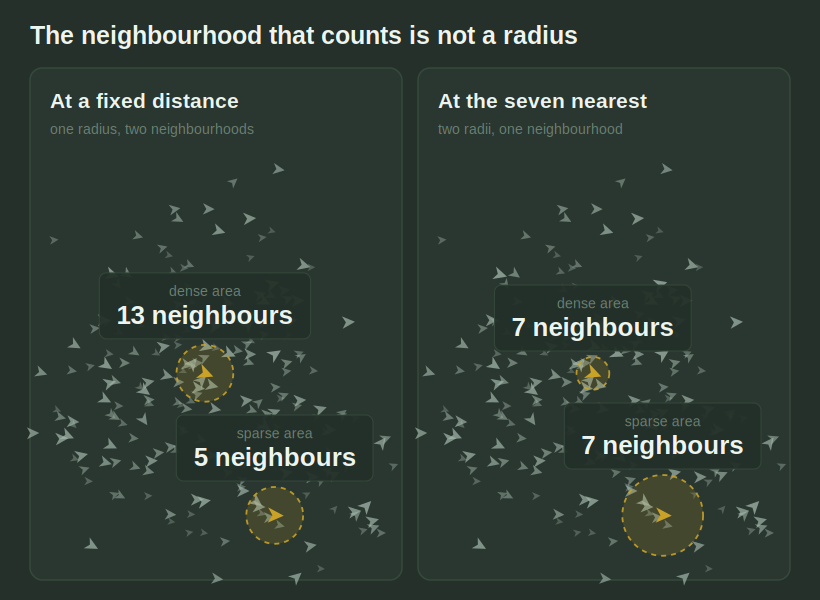
A neighbourhood defined by distance empties as soon as the group stretches, and saturates as soon as it contracts. A neighbourhood defined by rank does not change: the flock can expand and tighten without anyone losing their interlocutors. That is what holds it together.
So the starling does not know the murmuration.
It knows what is happening around it.
And that is enough for the shape to exist.
The chain nobody knows
We speak readily of a “food chain”.
The phrase gives a reassuring picture. A producer, then a processor, then a wholesaler, then a retailer, then a consumer. Links lined up one after another.
Reality rarely looks like that.
A producer sells to several cooperatives or wholesalers. A mill buys from several producers. A baker sometimes changes flour, has kept the same butter supplier for ten years, buys fruit elsewhere depending on the season. The haulier serves dozens of businesses. A certifier works with some of them. A vet, a laboratory, a local authority, a label or a journalist each know still other fragments.
Everyone knows a part.
Nobody knows the whole.
The baker knows where the flour comes from. They don’t necessarily know their miller’s other customers.
The miller knows their grain growers. They have no idea what each consumer will do with bread produced several relationships downstream.
The producer knows who they sell to. They don’t always know where the product ends its journey.
And this is not merely information each of them happens to lack. Some properties of a network are in none of its members: they are between them, and no individual record can declare them, because no company knows them about itself.
Yet the network exists.
It existed yesterday. It will exist tomorrow. It exists even though nobody drew it.
The registry comes after
This is an important distinction.
A registry may be tempted to build a representation of the world, then ask the world to fit inside it.
It defines categories. It imposes a hierarchy. It decides what counts as an important relationship. Then it works to complete its table until it can claim to know the chain.
The murmuration suggests the opposite approach.
Start from relationships as they exist.
This one produces that.
That one buys from this one.
These two businesses have worked together for twelve years.
This laboratory analysed this batch.
This body issued this certificate.
This restaurant uses this product.
This claim comes from the company itself. That one from a third party. Another comes with a document. Another still is the result of repeated observation.
Each actor contributes what they know from where they stand.
The registry connects.
Little by little, a shape appears.
A registry therefore does not create the network it represents. The supplier waits for nobody to deliver to their customer. The producer waits for nobody to farm. The restaurateur waits for nobody to choose their produce.
The registry comes after those acts.
All it does is let their relationships become visible from one another.
Seeing further than your neighbour
The murmuration gets more interesting still when something changes.
A predator approaches. A few birds alter course. Those around them react. Then others. The turn crosses the group as a wave, at constant speed — it does not damp out as it travels from where it started, the way a rumour would.
Information travels the flock even though no starling is watching the thousands of birds that make it up.
Two years after the seven-neighbour measurement, the same team showed that certain movement correlations extend across the whole group: the larger the group, the further they reach. The interaction stays local; its effects become global.
A registry can produce something analogous, without pretending to turn a company into a starling.
A producer adds the origin of a batch.
That information concerns their buyer.
It may then concern the product that buyer transforms, then whoever uses it, then whoever is trying to understand what they are buying.
Local information becomes relevant far from where it started.
But it must not lose its history along the way.
Who declared it?
What is it based on?
When was it established?
Has it been verified?
By whom?
To which product, batch, site or relationship does it attach, exactly?
Movement may propagate. Provenance must not disappear.
A number is a projection, not the shape
From the ground, a murmuration can be magnificent.
Suppose we asked an observer to score each bird out of a hundred. They could do it. They would produce numbers, and the numbers would not be false. But they would have to say where they were standing — and another observer, positioned elsewhere, would produce a different score for the same bird, equally correct.
This blog has already settled that question, and not in the direction you might expect from a piece about emergence. Reading Ludwig von Mises on the calculation problem, the conclusion was that the trouble was never calculating. It is calculating once, for everyone, and calling the result the value.
Because the things being aggregated are not of one kind.
A company holds certificates. It states certain practices. Others verify them. It has worked with the same customer for fifteen years. Several batches have been traced. A buyer comes back every week. A trade body lists it. An old piece of information has just been corrected.
A commercial relationship observed over ten years is not a five-star review.
A certification is not a statement.
A statement is not a laboratory analysis.
An analysis is not a repeated relationship.
Their arrangement already says something, before any addition. A registry must therefore preserve those differences — and when it derives a number from them, attach to that number what it demands of everything else: an author, a method, a version, input data, a date, a scope.
On that condition the number stops being a property of the bird. It becomes what it is: one view, taken from one position, of a shape that admits several.
The consumer will not look for the same thing as a school-canteen buyer.
The restaurateur will not ask the same questions as the certifier.
The shape is shared.
The gaze stays situated.
Nobody owns the drawing
There is one last lesson in the sky.
No starling can claim the shape.
The one flying in the middle knows it no better than the one flying at the edge. Neither could reproduce it alone. None can say: this figure is mine.
It is the result of their relationships.
The same holds for economic networks.
A platform can record a relationship between a producer and a wholesaler. It did not create that relationship.
It can make a certifier’s work visible. It did not carry out the audit.
It can connect a product to a restaurant. It neither grew the one nor served the other.
The more useful the registry becomes, the more that modesty matters.
Infrastructure can make the shape visible without claiming to become the shape.
That may in fact be its function.
Because what we call a chain does not wait for an information system to build it.
It is already working.
It is already trading.
It is already transforming.
It sometimes remembers.
It often forgets.
It continuously produces new relationships.
We ordinarily see only a few at a time, the way a starling sees only the birds around it.
Then, once enough relationships become visible, something appears.
No starling knows the murmuration.
No actor knows the chain.
That does not mean it has no shape.
It means the shape belongs to nobody.
—
The flights described here are those of the STARFLAG project, reconstructed in three dimensions above Rome. M. Ballerini et al., “Interaction ruling animal collective behavior depends on topological rather than metric distance”, PNAS, 2008: interaction runs on six or seven neighbours counted by rank, not on a distance. A. Cavagna et al., “Scale-free correlations in starling flocks”, PNAS, 2010: the range of movement correlations grows with the size of the group. A. Attanasi et al., “Information transfer and behavioural inertia in starling flocks”, Nature Physics, 2014: a turn crosses the flock as a wave that does not damp out.
Hvad det betyder for dig
Den samme tankegang udspiller sig forskelligt, afhængigt af hvor du står i kæden.
Du er producent
You know your direct buyers, and that is already a lot. What you can’t see from where you stand isn’t a failure of your bookkeeping: nobody sees it from where they stand either.
VeraTrace til producenter →Du er grossist eller handler
Your position lets you see more relationships than most of your partners. It still doesn’t give you the whole chain — and a tool promising you the whole of it would be selling you a picture, not information.
VeraTrace til grossister →Du er distributør eller indkøbscentral
A supply-chain map isn’t a table to be filled in until it is complete. What makes it useful isn’t its coverage, it’s that every relationship in it says where it came from.
VeraTrace til detailhandlen →